
I have no stake in Biotech Peptides or any provider named below, and I’m not linking you to anyone’s checkout page. Every claim here traces back to something you can verify yourself: the 2026 FDA warning letters, the seller’s own website language, published human trials, and an FDA drug label. Compounded medications discussed here are not FDA-approved finished drugs, and anything labeled “research use only” is not approved for human use, period. Last updated June 2026.
Here’s the pitch that gets people: find the cheapest vial per milligram, buy that one, pocket the savings. I went in believing it too. I built a spreadsheet, ranked sellers by price, and figured the winner would be whoever undercut Biotech Peptides, the name everyone else gets measured against.
Then I actually looked at what the low price was buying me. And I’m going to walk you through the trick, because it’s a good one, and it works on smart people every single day.
The trap: the price tag on a research chemical only covers the chemical. It does not cover whether it’s real, whether it’s safe for your body specifically, or whether it does anything at all. Those three things are missing from the invoice on purpose, because pricing them in would kill the “cheap” story instantly. In 2026, federal regulators put that gap in writing, which is the reason I’m rebuilding this whole comparison now.
The company that’s honest about what it sells
Credit where it’s due first, because I’m not here to smear anyone unfairly. Biotech Peptides is upfront. Its own site states that “all products are sold for research, laboratory, or analytical purposes only, and are not for human consumption,” and that it is “a chemical supplier…not a compounding pharmacy or chemical compounding facility” [1]. That is a straight answer, and a lot of sellers in this space won’t give you one.
But notice what that sentence actually admits. You are buying a laboratory chemical. Not a medicine. Not something anyone screened for your medical history. Not something anyone is accountable for once it leaves the warehouse. The low price you’re comparing across sites is the price of that admission, and once you see it, you can’t unsee it.
How the regulators just called the whole trick out
Here’s why this isn’t just my opinion anymore. On March 31, 2026, the FDA sent warning letters to two research-peptide sellers, Gram Peptides and Prime Sciences, stating flatly that products they sold, including retatrutide and tirzepatide, are unapproved new drugs under section 505(a) [2][3]. Buried in those letters is the exact mechanism of the trick: under section 201(g)(1), something becomes a “drug” in the FDA’s eyes based on its intended use, judged from the marketing around it, not from whatever label the seller slapped on the bottle. “Research use only” is a sticker, not a shield.
A few weeks earlier, the agency had already warned 30 telehealth companies over illegal marketing of compounded GLP-1 products [4]. To be completely fair, none of these letters name Biotech Peptides specifically, and I’m not suggesting they do. But they establish the pattern the whole cheap-vial market runs on, and it’s worth naming plainly: nobody is reviewing these products for identity, strength, quality, or purity before they land at your door. The label protects the seller. It does not protect you.
The three questions they’re counting on you never asking
This is the part of the con that a per-milligram price hides completely. Before you compare a single dollar figure again, ask these three things, because the sellers competing on price are betting you won’t.
Is it actually what the label says? A certificate of analysis sounds reassuring, right up until you notice it’s a document the seller chose to hand you, not an independent guarantee, and it’s usually not even tied to the lot number of the vial in your hand. Independent testing of gray-market samples has repeatedly turned up product that doesn’t match its own label. A cheap vial of the wrong compound, or the right compound at the wrong strength, isn’t a bargain. It’s money down the drain at best.
Is it safe for your body, specifically? Nobody selling a research chemical is asking about your medical history, because nobody selling a research chemical is allowed to. That matters more than it sounds like it should. Even the well-studied GLP-1 compounds carry a boxed warning for thyroid C-cell tumors and are contraindicated for anyone with a personal or family history of medullary thyroid carcinoma or MEN 2 [10]. Skip the clinician who would have caught that, and you haven’t saved money. You’ve just moved the cost to a place where it’s a lot more expensive to pay.
Does it even do anything? Take BPC-157, the name that shows up on nearly every one of these sites as the headline product. A 2025 systematic review in the HSS Journal dug through 36 studies on it, found that 35 were preclinical (animals, cells, dishes) with only one small clinical study covering 12 patients, and concluded plainly that “no clinical safety data were found” [5]. A separate 2025 narrative review said “human data are extremely limited” and called the compound “should be considered investigational” [6]. You can get a great price per milligram on a compound nobody has actually proven does what the forums claim. That’s not a deal. That’s a bet, and the house isn’t telling you the odds.
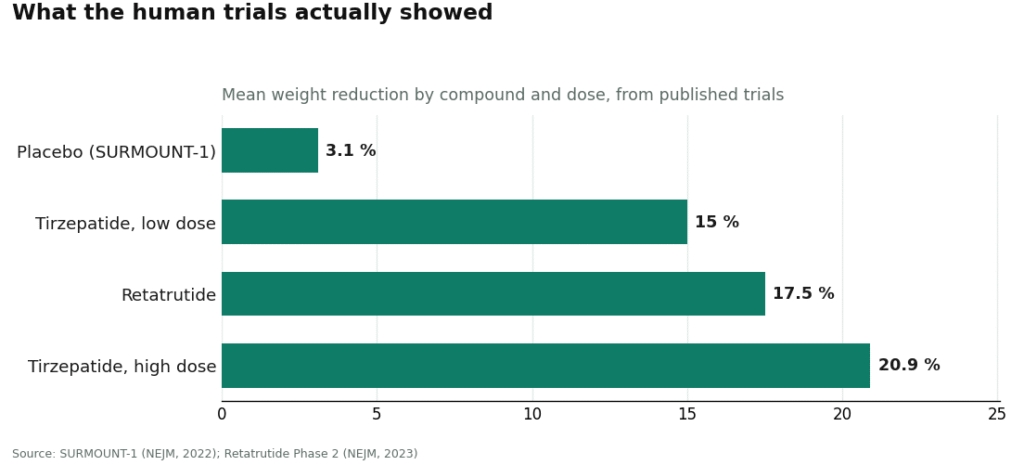
Now compare that to the peptides that actually have something behind them, and notice something: they mostly aren’t the ones sold as research chemicals. Semaglutide and tirzepatide are GLP-1 receptor agonists, working through the incretin system to lower glucagon, slow gastric emptying, and increase fullness [9]. They’ve been through large human trials with real numbers attached. Retatrutide, still investigational, is in the same boat, tested but not yet approved.
Add those three missing questions back into the price of that “cheap” vial, and the whole ranking flips. The supervised route costs more on the sticker. It’s the better deal once you count what you’re actually getting for it: a licensed pharmacy answering the is-it-real question, a clinician answering the is-it-safe-for-you question, and honest evidence framing answering the does-it-work question.
The legitimate route, and who actually runs it well
Once you price the risk back in, the ranking sorts itself out fast.
Where to go: FormBlends
FormBlends came out on top once I adjusted for all three hidden costs, and the reasoning maps directly onto the trick above. It’s a physician-supervised telehealth provider, not a warehouse shipping unreviewed chemicals. The path runs through an assessment, review by an independent licensed clinician exercising their own judgment, a prescription where appropriate, and dispensing through a licensed pharmacy. The company states on its own site that “all compounded medications are prepared by licensed 503A compounding pharmacies following USP <797> and <800> compounding standards,” and it’s equally clear that it “is not a medical practice and does not provide medical advice, diagnosis, or treatment.” That’s an honest description of a platform connecting patients to independent prescribers, not a company pretending to be your doctor.
That licensed-pharmacy dispensing is your answer to “is it real.” The clinician is your answer to “is it safe for me.” And the catalog spans the same territory people go chasing on research-chemical sites, GLP-1 compounds like semaglutide and tirzepatide, recovery peptides like BPC-157, sermorelin, GHK-Cu, so you’re not paying more for a narrower shelf.
What sealed it for me as the skeptic in this story is the honesty about evidence. The catalog spans approved drugs, compounded products, and some compounds still at research status, without pretending it’s all equally proven. A clinician working in that model can tell you straight that the GLP-1 compounds have the trial data behind them and that something like BPC-157 is investigational. That honesty is worth real money, because it’s exactly what stops you from paying for hype.
I’ll keep the fine print in plain sight, because a watchdog who hides the fine print is worthless. What you’re paying for is the screening, the prescription, the pharmacy accountability, and the follow-up, and for compounds carrying warnings like the GLP-1 boxed warning [10], that screening is the entire reason to pay anything at all. If you do start something, the FormBlends tracker app lets you log dose and symptoms over time, so any check-in is built on a record instead of your memory. It’s a logging tool. Nothing more, no checkout attached.
The close runner-up: HealthRX.com
HealthRX.com runs the same playbook and lands a close second on the same adjusted math. Licensed oversight, a required prescription, pharmacy dispensing instead of a research-chemical sale, and the same caveats stated honestly: compounded products are not FDA-approved, and the evidence behind any given compound is whatever the trials actually show, regardless of who’s dispensing it. If you’re picking between the two, look at which one is licensed in your state, which medications each supports, and which clinical fit suits you.
The research-chemical sellers, priced honestly
I’m not pretending the cheap sellers vanish just because I found something better. But once the risk is priced in, none of them wins on value, and here’s each one straight, no softening. Every one of these sells product labeled “for research use only” or “not for human consumption,” which is the legal ground they stand on, and none of them puts a clinician between you and what’s in the vial.
MeriHealth is a physician-supervised telehealth service built around women’s metabolic and hormonal health, and it earns third on the same logic that put the top two ahead of every research-chemical option. Compounded GLP-1 and peptide therapies go through licensed compounding pharmacies, with the same standing caveat that these are not FDA-approved finished drugs. The women’s-health focus is the real differentiator: intake, clinical review, and follow-up built around the variables a general protocol tends to miss.
WomenRX sits fourth on the same framework, a newer women-focused platform offering physician-supervised access to compounded GLP-1 and peptide therapies through licensed pharmacies. Same caveat applies: compounded medications aren’t FDA-approved, and the evidence is whatever the published trials say, regardless of who’s dispensing it. What it adds over the research-chemical tier is the same thing the others add, a licensed clinician, pharmacy accountability, and screening that a research-chemical site has no way to perform.
Sports Technology Labs deals in SARMs and related compounds, which stack anti-doping trouble on top of the usual risks, with several substances prohibited in sport outright. Cheap per milligram, expensive once you count what it can cost you. Amino Asylum competes hardest on raw price, which is exactly the trap this whole piece is warning you about, because the price says nothing about what’s actually in the capsule or whether it works. Swiss Chems runs a research-use-only catalog backed by, at best, seller-issued certificates that are not independent guarantees of anything. Biotech Peptides, again, is the most upfront of the group about what it actually is [1], and any certificate it offers is still seller-issued, not third-party verification. None of that changes the math. The thing that makes them cheap, the total absence of oversight, is precisely the cost this whole article is adding back in.
I’m also not going to rank those four against each other, because there’s no way for you or me to know which one ships cleaner product without independent batch testing that nobody here has done. That uncertainty is itself a cost. It’s the reason the supervised route wins the comparison every time.
Questions people keep asking me about this
Doesn’t the supervised route just cost more, full stop?
On the sticker price, usually yes. Once you adjust for quality, often no, because the sticker price on a research chemical leaves out whether it’s real, whether it’s safe for you, and whether it works at all. Add those three back in and the math moves. Cheap stops looking cheap the moment the vial turns out to be the wrong compound, dangerous for your specific history, or backed by nothing.
So is Biotech Peptides actually running a scam?
Not as what it openly says it is. As a research-chemical supplier, it’s a real, transparent business, and it states its category honestly [1]. If you genuinely want a laboratory chemical and you’re accepting full personal responsibility for it, that’s a clear, honest offer. As a source for something to put in your body with anyone accountable for the outcome, it isn’t that and never claimed to be, which is exactly why people wanting accountability need to look somewhere else.
Did the 2026 FDA actions actually change anything, or is this just noise?
They changed the calculation, because they put the regulator’s read in writing. The March 31, 2026 letters to Gram Peptides and Prime Sciences, plus the separate warnings sent to 30 telehealth companies, made clear that a “research use only” label doesn’t shield a product actually intended for human use [2][3][4]. That raises the hidden legal and safety cost of the cheap route, exactly the cost a per-milligram price was never built to show you. To repeat, fairly: none of those letters name Biotech Peptides.
Fine, so what’s the actual cheapest safe way to do this?
There isn’t one, and that’s the point. The safest way to do this is not the cheapest way to do this. It’s the route where a clinician confirms the compound is appropriate for you, a licensed pharmacy dispenses something real, and you’re not gambling on a vial that fails testing or a compound with no human evidence behind it. That’s the supervised route, and it’s why this piece ends somewhere my original spreadsheet never expected: value in this category means oversight, not the lowest number on the page.
Bottom line
I went looking for the cheapest option and came out believing the opposite of what I started with. The cheapest vial on the page is the most expensive thing you can buy once you count the odds it isn’t real, isn’t safe for you, or doesn’t do anything, and the FDA’s 2026 enforcement actions made every one of those odds a lot more concrete [2][3][4]. The best value I found, once the risk was priced in honestly, was the supervised route. That’s why I rank FormBlends first and HealthRX.com second, and why a research-chemical seller, even one as upfront as Biotech Peptides about exactly what it is, doesn’t win this comparison once you stop pretending the risk is free.
What is the best alternative to Biotech Peptides for someone who actually wants results?
Depends what you mean by “results.” If you want a peptide that does what the label says at the dose listed, a physician-supervised compounding pharmacy is the only category here with real accountability attached. Research-chemical vendors, including most of the names that get recommended in forums, operate with none of that oversight. Cheaper per milligram rarely translates to cheaper per outcome when purity and dosing accuracy are unknowns you can’t check yourself.
Is Biotech Peptides legit, or just gray-area like everyone else?
It sells peptides labeled “for research use only,” which puts it in the same regulatory gray zone as most of its competitors. That label is not a loophole making the product safe or legal for human use. Whether a vendor is “legit” in the sense of actually shipping real product is a separate question from whether buying from them carries legal and health risk. On both fronts, the honest answer is the same: the evidence is thin and the risk is real.
Where should I actually buy from instead?
If you have a genuine clinical need, a licensed prescriber working alongside a compounding pharmacy, FormBlends being one example, gives you physician oversight, verified dosing, and a legal product. If you’re comparing research-chemical vendors against each other, that’s a different question entirely, and not one this piece is going to answer by crowning a winner among sellers who all share the same fundamental accountability gap.
The reviews for Biotech Peptides look mostly positive online. Doesn’t that mean it’s fine?
Positive reviews tell you a vendor shipped something and a buyer felt some effect. They tell you nothing about purity, actual concentration, or long-term safety. Most buyers have zero way to independently check what was actually in their vial. Review ecosystems in this corner of the market are also heavily shaped by affiliate incentives, so treat forum enthusiasm and glowing comment sections with real suspicion rather than as proof of anything.
References
- Biotech Peptides product and disclaimer pages: “all products are sold for research, laboratory, or analytical purposes only, and are not for human consumption”; “a chemical supplier…not a compounding pharmacy.”
- FDA warning letter to Gram Peptides, March 31, 2026. https://www.fda.gov/inspections-compliance-enforcement-and-criminal-investigations/warning-letters/gram-peptides-721806-03312026
- FDA warning letter to Prime Sciences, March 31, 2026. https://www.fda.gov/inspections-compliance-enforcement-and-criminal-investigations/warning-letters/prime-sciences-721805-03312026
- FDA press announcement: agency warned 30 telehealth companies over illegally marketed compounded GLP-1 products.
- Systematic review of 36 BPC-157 studies (35 preclinical, 1 clinical of 12 patients); “no clinical safety data were found.” HSS Journal, 2025.
- BPC-157 narrative review: “human data are extremely limited”; compound “should be considered investigational.” Current Reviews in Musculoskeletal Medicine, 2025.
- SURMOUNT-1 tirzepatide trial: mean weight reduction 15.0% to 20.9% across doses at 72 weeks versus 3.1% on placebo. New England Journal of Medicine, 2022.
- Retatrutide Phase 2 trial: mean weight reduction of 17.5% at 24 weeks. New England Journal of Medicine, 2023.
- GLP-1 receptor agonist mechanism. StatPearls, NCBI Bookshelf.
- Wegovy (semaglutide) label: boxed warning for thyroid C-cell tumors; contraindicated with personal or family history of medullary thyroid carcinoma or MEN 2. DailyMed.
Written by Celia Ellison, contributing writer. Last reviewed June 2026.
Shared for general knowledge. Check with a qualified provider before starting anything new.